
Your company has values. But would your employees recognise them?
Tomorrow is World Values Day, which feels like a good time to ask a slightly uncomfortable question: If I asked the people who work in your organisation what really matters there, would their answers match the values written on your website?
The answer probably depends less on whether they can remember your stated values and more on the culture they experience every day at work. Organisational culture is shaped not only by the things companies say and what we can see, but also by the unwritten assumptions, about “how things are done around here”. Those everyday experiences tell people far more about what an organisation really values than the words on a website ever could.
For leaders and organisations, this matters because employees are constantly interpreting these signals and using them to work out what is genuinely expected, valued and rewarded.
What do your company values actually look like in practice?
Many companies state values on their company website, in their employee handbook and strategic intents. However, the more hidden company norms and expectations can hinder these values from actually becoming enacted values – those the company actually practices.
For example, a company may say:
“We value trust” → but everything is checked and approved.
“We value wellbeing” → but emails are sent and received well after work hours.
“We value innovation” → but ideas are dismissed and mistakes are punished.
“We value people” → but productivity is prioritised over people experience.
“We value inclusivity and flexibility” → but everyone is expected to be in the office five days a week, regardless of role or individual need.
What does your organisational culture say really matters?
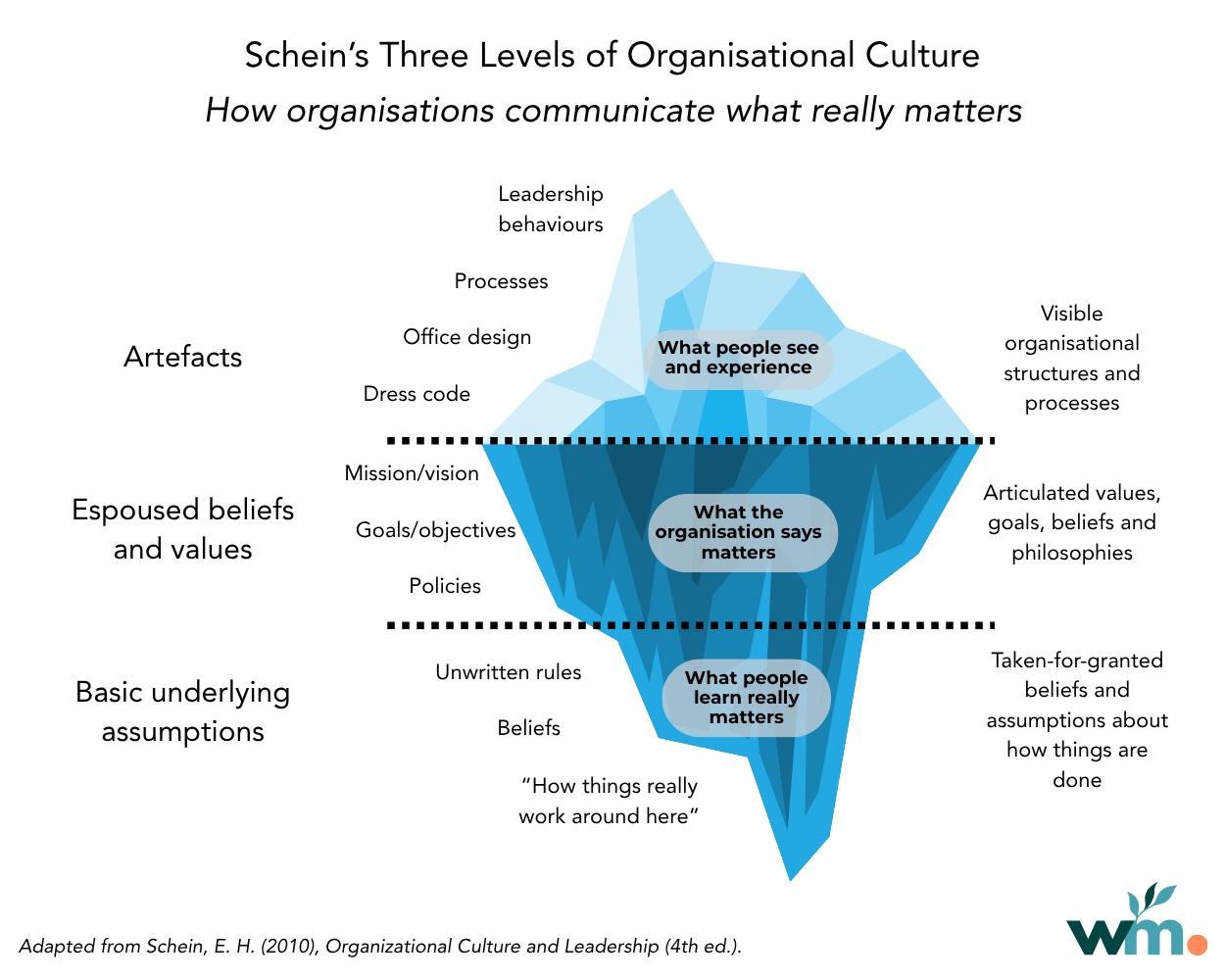
Schein's (2010) model of organisational culture helps explain this better.
Often represented as an iceberg, it shows how some parts of culture are easy to see, while others sit beneath the surface. Employees gradually absorb these cues from the environment, watching what others do, who and what gets rewarded and how people are treated when things go wrong to uncover the unwritten rules and hidden shared beliefs within the organisation.
What happens when your values and culture tell different stories?
When people join an organisation, they often arrive with an impression of what working there will be like. They may have read the company mission, vision and values, looked through the website or heard about the culture during recruitment. When that picture doesn't match what they experience in practice, it can feel a little like false advertising.
Imagine a new employee arriving at a bright, glass-fronted office. People dress casually, there are colourful breakout spaces, good coffee and even a massage chair. These are the Artefacts of the culture – the things they can immediately see and experience. Their first impression might be: this feels creative, modern and forward-thinking.
Then they meet the founder, who talks enthusiastically about innovation, wellbeing and development. The company offers unlimited holiday and a generous learning budget. These are its Espoused values – what the organisation says matters. The new employee is delighted. They enjoy challenging work, but they also value travel, downtime and opportunities to learn.
Then they begin to discover how things actually work in practice.
In meetings, people talk over each other and new ideas are quickly dismissed. Working evenings and weekends is normal. Holiday allowances and learning budgets remain largely unused because workloads are so high. Mistakes may be talked about as learning opportunities, but people quickly learn that making one carries a cost, potentially stifling innovation and creativity.
These are the Basic Underlying Assumptions and unwritten rules beneath the surface: what people learn really matters in an organisation.
The value-culture gap
For this employee, the gap between the culture they expected and the culture they experience could affect their sense of belonging, motivation and connection to their work. They haven't simply discovered that the organisation works differently from expected; they've discovered that some of the things they personally value aren’t reflected in the way the organisation actually works.
This mismatch doesn’t only affect new employees, organisational cultures can change. Changes in leadership, structure, workload or policies can gradually shift the way work feels, even when the values on the website remain unchanged.
Employees can then find themselves working in an organisation that no longer feels like the one they originally chose to join. This is something I often hear in coaching when a company has restructured or the leadership has changed.
From an organisational perspective this is where a culture-values gap can be incredibly important. You may be communicating the same values as before the changes, but employees are experiencing a different workplace to before. For leaders, that means values need to be revisited in practice, not just reviewed as statements.
So, if you influence culture in your organisation, how can you make your values more than words on a website?
Start with one core value and consider:
Where would employees actually see this value in action?
What behaviours do we reward that support, or contradict it – both overtly and subtly?
What can we change to align more closely with the value?
Your values are already visible whether you intend them to be or not. Perhaps the real test of organisational values isn't whether employees can remember the words on your website. It’s whether they can recognise them in the way work actually feels.

Dr Phoebe Simmons is a Chartered Psychologist, Coaching Psychology Practitioner and Director of What Matters Group. She holds a Professional Doctorate in Coaching and Mentoring, with research focused on meaning in life and coaching, and is an EMCC EIA Senior Practitioner. Her work draws on psychological research to explore meaning, motivation, strengths, wellbeing and the experience of work, helping individuals and organisations create better working lives through coaching and organisational development.
Find out more about Phoebe and What Matters Group
Follow me on LinkedIn
View my research here on ResearchGate